

1/4 Wild
Volume 5, Issue 8, September 1998

Bob Seals was a madman, at times. Still is, maybe. I met him somewhere around 1990 at one of the sadistic races he was hosting on his property outside of Chico, and then remember blatantly propositioning him at the Shasta Lemurian the next spring for a chance to race one of his new Retrotec cruisers. He had no reason to sport me a frame. I wasn’t that fast, and he by that time had Dan Bogan and Donny Ferguson racing for him, as well as rapidly up and coming Rob Sears, and Darin Smedberg, and Kim Dow, and Mike Galeoto, and a whole slew of other fast as fuck racers and feral beasts from all over NorCal. But he gave me a frame anyway and let me wear the cool Kucharik checkerboard kit, and I did what I could not to barf on it.
The Cool Tool bus was a rolling experiment in anarchy and acceptance. It was pure mayhem. I never traveled on the Bus, so the stories from that time are for other people to tell. But I wrenched for them at the races a couple times, and in return they fed me, along with half the starving and perpetually hungry other feral racers who were stringing together their seasons from one paycheck to the next. In Mammoth in ‘91 or ‘92, Bob was helping Jake Watson steamroll his way through the slalom by standing at the bottom of the course with a wad of $20 bills. Every time Jake made it through a run, Bob would stuff another 20-spot into Jake’s pocket. Since I was riding a Suspenders fork at the time and Jake was racing a Mountain Cycle San Andreas, it fell to me to try and keep his bike from breaking. Jake was very big, and very strong. It was a harrowing weekend.
Bob brought a sense of much needed wildness to the race circuit in the 90s. The scene was always in danger of toppling over under the weight of its own newfound self-importance, and Bob’s crew was there to remind everyone that none of this is worth taking that seriously. I wrote this piece about him in 1998, two years after his scandalous 1996 ejection from the expo area at the Mammoth NORBA national. He, along with the many incredible people he drew into his orbit, continues to inspire me to this day. Thank you for being, Bob.
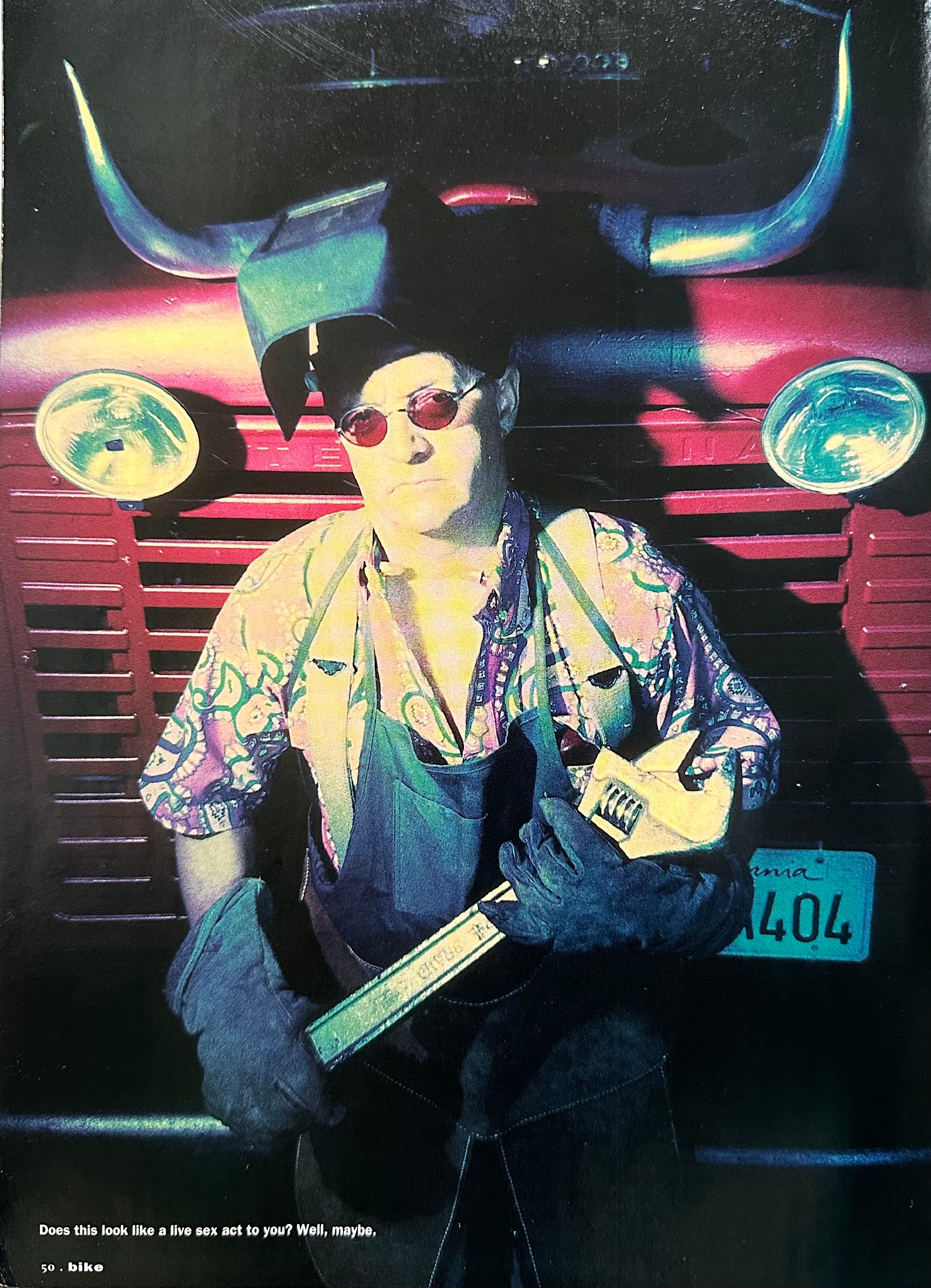
¼ WILD
“OK, you want to know what happened at Mammoth? Here’s what happened at Mammoth. We were down there for the national, I guess in ‘96, the year they started charging spectators two bucks a pop to get into the expo area. Which seems like a good way to make sure no one buys anything. Anyway, we were there with the bus, we’d paid our $900 to be there, the stage was set up, and we had a few kegs of microbrew going. We were having a party. It was after the expo had closed down for the day, there was nobody there except for the usual industry folks, and we were drinking.
“So, one thing led to another, and before long I was riding around naked on the tandem, and I guess that pissed some people off. And I’d been pumping the keg with my ass and pissing off the edge of the stage, which everyone had seen me do before, anyway, which we’d pretty much been doing all season, and I guess that really pissed some people off. But it’s not like there were mothers and children there watching. The place was deserted, except for about 40 or so people who were hanging around at the party and a few exhibitors. But some of them really wanted to kill us, and we were like, ‘Look, if you don’t like this, don’t watch. Go home; we’re just minding our own business here.’
“Anyway, the next morning two national forest rangers show up, hands on their guns, and tell us we have to leave. During the men’s pro race. They bring in a forklift to move a couple other trailers out of the way, cut a hole in the chainlink fence they’d put up to make sure nobody snuck into the expo without paying, and escorted us to the boundary of the Inyo National Forest like we were some sort of criminal threat. For being drunk and naked. I go, ‘What about the people who streaked down to Whiskey Creek the other night?’ and the ranger says, and I’m not kidding, the ranger says, ‘Do you know their names?’, like he wanted me to rat out the other perverts who were desecrating their national forest.”
—Bob Seals, when asked, “So, what did happen at Mammoth two years ago?”
The 1996 expulsion of Bob Seals and the Retrotec/Cool Tool bus from Mammoth marked the end of a decade-long assault on the status quo of mountain bike racing by Bob and his racers. Within a week, the rumor of what had transpired orbited and, as rumors are wont to do, had grown to monstrous proportions: Bob Seals was kicked out of Mammoth for having a live sex act on his stage. Bob Seals had poured a washbucket full of urine over the MountainSpeed booth at Mammoth. Cranes had been brought in to lift Bob Seals and the Retrotec bus out of the expo area and escort them all to jail. In one afternoon, Bob had gained more notoriety than he’d managed in the previous decade. It was quite an accomplishment, given that said decade had seen the invention of the Cool Tool, the Retrotec bicycle, and the Bus – all created by the hands of a stocky, flamboyant man fond of racing one-speeds at national events in a red Speedo and a Pro-Tec skate helmet painted to look like a brain.
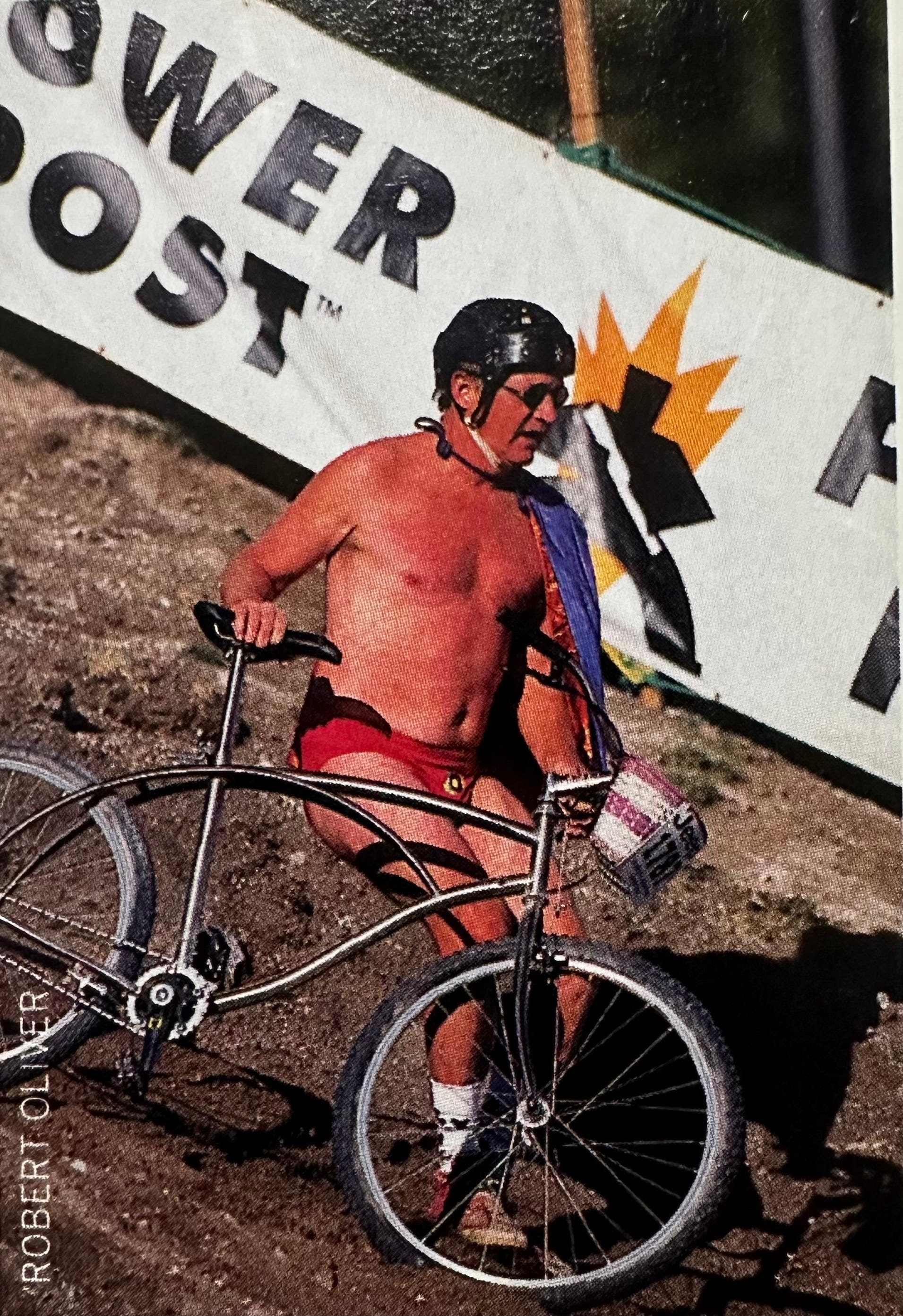
Robert Lynn Seals was born 53 years ago in Chester, California. A quiet town in the northern Sierra Nevada, Chester’s 50 miles eastward and 38,000 people smaller than Chico, where Bob has lived, on his 70-acre ranch amidst an ever-revolving menagerie of dogs, pigs, peacocks, chickens, people, and heavy metal objects, since 1965. In Chester, people call him Robert Lynn. In Chico, he’s Bob. Sandy hair, starting to thin and go gray, tops a head that sometimes seems turtle-ish, which in turn sits atop a barrel-chested and very slightly bow-legged body. He wears a Hawaiian shirt well, with a sort of Joe Pesci demeanor. You know he’s looking for a good time but aren’t sure if you really want to be around when it occurs. During his life he has been, among other things, a ski racer, a welder, a musician, a smoke jumper, a stock car racer, a bicycle tool and frame manufacturer, and a metal sculptor.
After sidling into bicycles in the late ‘6os, when a toe injury made it impossible to run hill sprints as training for the ski race season, Bob eventually found himself with a mountain bike in 1987. He also had some land. So he started putting on races – steep, heinously hot and dusty affairs held on the red and rocky singletrack that he’d carved into his property just east of Chico, known for a short while as the Foothill Bike Park. At one of these races, somebody’s neon pink and black saddle bag got tired of the relentless jackhammering and fell off the bike it had been part of. Bob found it, looked at all the tools assembled there-in, and thought, “There has to be a better way.” A few hours in the shop hacksawing, bending, and welding various tools together resulted in a crude multi-tool. Which in turn gave rise to the Cool Tool: a chain breaker/crescent wrench/4, 5, 6, 8 Allen wrench/14mm crank bolt tightener/Philips head screwdriver/spoke wrench all-in-one bicycle tool that set the standard for the multi-tools of today.
The Cool Tool took off and within a few years was selling at a rate in excess of 50,000 units per year. Just about anybody who owned a mountain bike in the early ‘90s had, at one time or another, a Cool Tool. One puzzle solved, Bob turned his attention elsewhere. Since becoming involved in mountain bikes, he’d been asking anyone with a frame jig and a torch to build him an off-road-worthy cruiser-something with the flowing curves and grace of an old ballooner but with contemporary geometry and tubing. Finally, he tired of asking others and started in on the project himself, introducing the first Retrotec race cruisers in 1990. By 1996, there were Chico-built cro-moly Retrotecs, Litespeed crafted titanium ones, Cool Tool had been bought by Gerber (the knives, not the baby food), and the Retrotec race team had a new bus with a fold-out stage. Bob’s latest fancy, a band called “The Wayhigh Patrol,” traveled to the races with the team, got up on stage, and did its thing. Some of the racers played in the band, some of the band members raced.
Which, in turn, brings us back to Mammoth, where Bob, his team, and the Bus (with its hand-painted mountain motif and 22-by-22-foot fold-out stage) said goodbye to the world of mountain bikes. With the goodbye went a collection of souls who had, for several years, been a source of free food for struggling racers as well as a grass-roots, fun-loving, bullshit-calling approach to competition and the often-anal-retentive way in which that particular war is waged.
Life at the ranch now consists of metal sculpture. Plough discs ruptured in the middle sprouting huge lizards and bouquets of steel wildflowers. A six-foot-tall Pegasus, cut from half-inch plate steel, its wings beaten silvery blue. A life-size hawk, drawn entirely from ribbons of steel and beads of weld, perched atop a several hundred-pound cylinder of solid metal, rusting beneath silvery talons. Bob, with the experience and equipment from a life of working with metal, is slowly filling up the ranch with fire-wrought vistas that only he can clearly see. “It’s always been about the art. I’ve always tried to bring the art into whatever I’ve been doing, but now I can just go crazy with it, and it’s great. You could take my life and throw it all away, but if there’s any one thing I could keep, it’d be the art.”
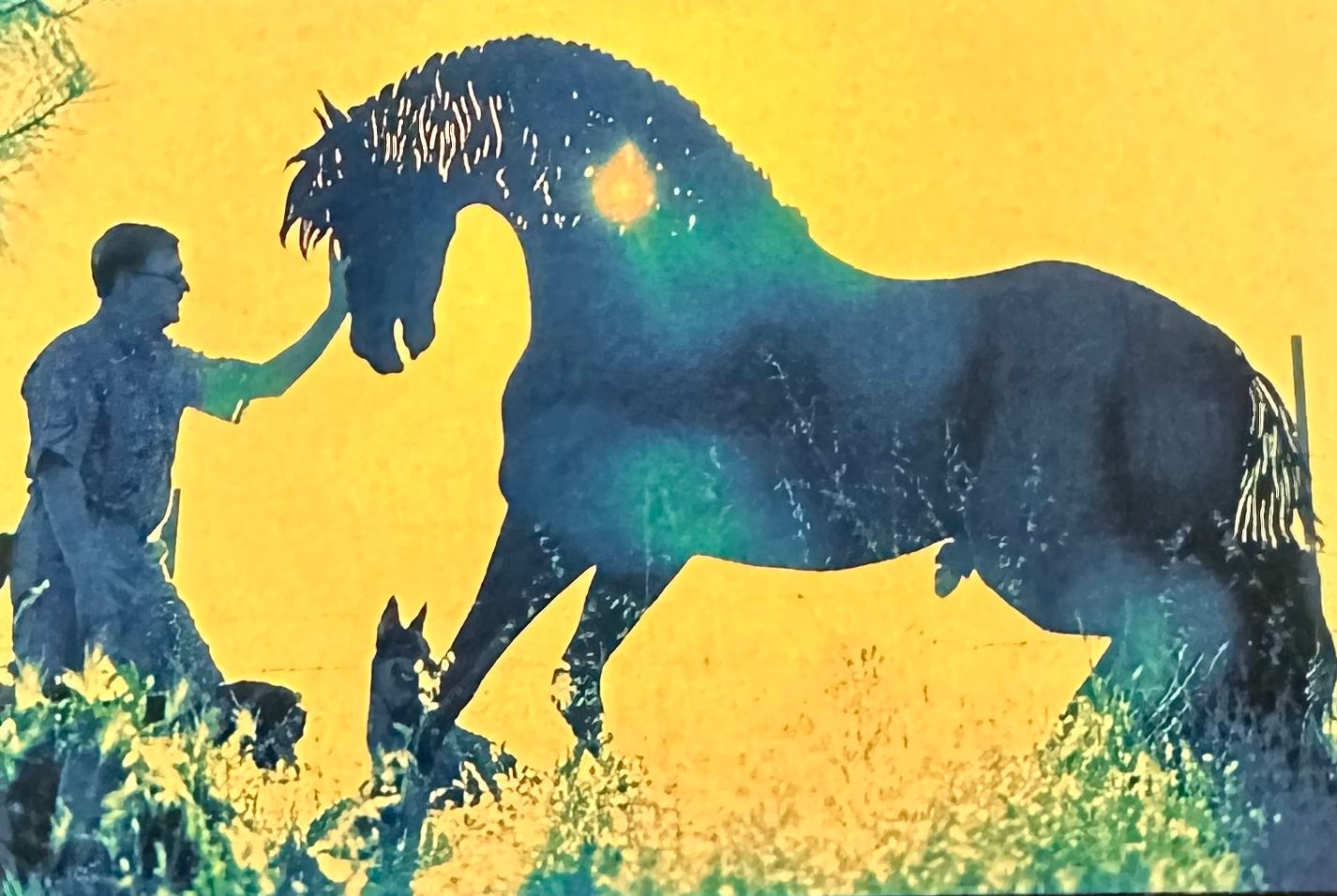
The lead image and this one were culled from the article as it appeared in BIKE, and were shot by Christian Schneider.
For all the cycling public’s impression of Bob as the merry prankster of the race circuit, as the whacked outsider who finally went too far, as the guy in the red Speedo, that would only be a shard of the whole scene. The nude riding, the drunken hooliganism, is what people saw when the Bus rolled up to one of a dozen or so race venues in the context of a race season. The invisible three quarters of the year, back at the ranch amongst towering edifices of bent and cut metal, the long hikes with the dogs, the soon-after-sunset bedtimes and crack-of-dawn awakenings, intimate knowledge of the plant and animal worlds on the ranch that can only come from years spent watching and listening, are what the public doesn’t see. They only see Bob the crazy man. Standing on a ridge overlooking a hidden meadow across the highway from the ranch, Bob pointed at a thistle jutting out of the shoulder-high grass. A long, wet winter had led to a mad growing season for the local vegetation. “See that?” he said, “Those thistles are going to have a field day this year. Usually they only get up to knee level. That one’s got to be seven feet tall. Tell you one thing, though. I’m willing to bet that we get wildfires this year like you’ve never seen before.”
Then, gesturing out across the valley before him, “See, this is the Bob Seals that nobody really knows about. Everybody sees me drunk and naked, getting obnoxious somewhere or other. They don’t see this.”
Which is not to say that Bob Seals has settled entirely into the bucolic life of country-induced slowdown. Up the path from the main house, outside the workshop, sits the Bus. Now primer black with flames and silver cowhorns, it’s being readied for the road again. The Stage now folds out to 30 by 40 feet, a huge canopy can be drawn over the entire bus and stage, making for one gigantic tent, and there are logos plastered all over the hull of a decidedly teen-angst nature.
Summer is coming, and the Bus is hitting the road as one of the stages for the Warped tour: a music, skate, street, young-thing extravaganza that will hit 34 cities nationwide in a six-week span. Bob and his crew (which includes a retired navy SEAL drill instructor, a former junior national rugby team member, and Bob’s nephew) will be responsible for setup and teardown of any bands performing on their stage, as well as featuring live metal sculpting work by Bob and his partner Okie.
“It’s amazing,” says Bob, “Everywhere you look, people are wondering how to control their kids, and, meanwhile, they keep making it harder and harder for kids to just be kids. ‘Skate parks? Oh no, can’t have any of those, too risky’ – kind of bullshit. And here we come with this tour, in places like Lawrence, Kansas, and we’ve got skate ramps, climbing walls, art shows, and music. It’s gonna be insane. Kids need stuff to do. If it weren’t for things like this, they wouldn’t have shit.”
Balancing the quiet life with his need for sometimes outrageous forms of self expression seems to be a recurring metaphor in the life of Bob Seals. It shows up in his art, where huge tracts of industrial scrap are used to craft lizards and flowers. It shows up in the pace of his life, where months of country living are offset by summers of intense, sometimes debaucherous, living. Now, after living for a couple years out of the often painfully conservative public eye, he’s ready to reemerge, this time into the world of rock music and skater life.
A good point to end this tale would be with his description of this scene from just after a fundraiser for the Warped tour last winter: “l’ve done some crazy things in this life and had plenty of opportunity to wonder how I might die, right? So there I was, thinking, ‘This is it.” Lying naked, covered with makeup, in a cage at some dive strip bar in L.A., surrounded by drunken, screaming snowboarders, while a 300-pound Samoan bouncer with a bullwhip thrashes at me, and all I can think is, ‘Sweet Jesus, please don’t let it end like this.’”
If we’re all lucky, it won’t end like that, and maybe he’ll show up again at Mammoth someday.
Postscript: Bob didn’t go back to Mammoth, and the ego-bubble of mountain bike racing popped hard the next year. Bob did, however, go on to invent the Kleen Kanteen, and later move on down to a little south of Santa Cruz where he continues to engage in spiritual expansion and occasionally pissing off the neighbors. He appeared in my office at Santa Cruz Bikes in 2011, right after I had been tasked with pounding on the chest of the corpse of Swobo, asking if maybe he could get some of them fancy woolen threads. I obliged. We talked, and I asked what he was into lately. He said “tonalities” and pulled a flute out of his pocket. My two dobermann hounds were in the office that day, and Bob went on to say that all living beings resonate at certain tonal frequencies, and that you can tap into that and communicate with anything that is alive. He began playing the flute, and damned if Zee and Devo did not fall completely into a trance right there in front of him.
Great story! I wasn't familiar with a Cool Tool. Searching gave me all kinds of products using the name now, until I found this article on NSMB. https://nsmb.com/articles/coolest-tool/